
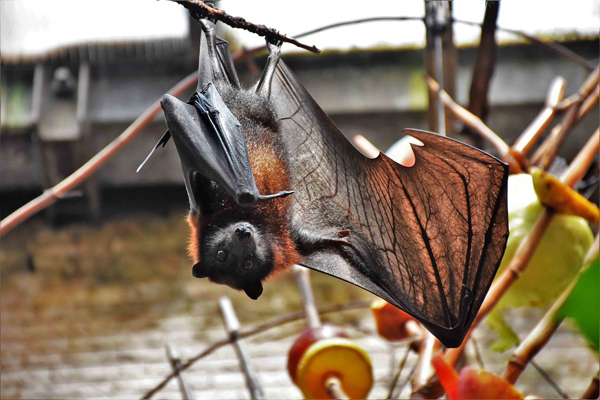
Bats are classic scary movie material. It’s easy to think of them as “predators”, but have you ever considered that they might be prey?
Despite this popular reputation, bats are actually incredibly important to our ecosystems. More than just creatures of the night, these animals play vital roles in controlling insect populations and pollinating flowers and fruits. In short, they’re pretty darn amazing.
Unfortunately, all this goodwill doesn’t stop bats from having predators of their own. So who or what exactly is out there snacking on these nocturnal creatures? Let’s take a look.
What Animals Eat Bats?
There are many, many animals that enjoy a good bat meal. In fact, you might be surprised to learn that some of the animals on this list are your common, everyday critters. Bats’ predators range from domestic animals to a number of wildlife species.
Here’s a look at some of the animals that eat bats:

Cats
Aha… these adorable yet conniving little pets. It’s no secret that cats love to hunt, and bats are definitely on their menu. Domestic cats, as well as larger felines like bobcats and cougars, will readily snatch up a bat if they get the chance.
Bats are nocturnal mammals, so they like hiding in places where it’s dark during the day. It can be your attics, porch roofs, chimneys, cable vents, and other small nooks and crannies. Unfortunately for them, this often puts them in close proximity to our furry friends napping spots.
And when a bat wanders into these areas, well… let’s just say the poor thing doesn’t stand a chance.

Owls
Owls are also nocturnal animals- creatures that are awake at night and sleeping during the day. They hunt alone or in pairs using their sharp claws and beaks to kill their prey. They have large eyes, which help them see in the dark. And their ears are asymmetrical, which means that they can pinpoint the location of their prey by sound.
Owls are common bat predators. There are many owl species, and each specializes in hunting different prey. The most well-known bat predators among them are the great horned owl (Bubo virginianus), tawny owls (Strix aluco), and barn owls (Tyto alba).
But, what makes bats a staple in their diets?
Well, for one thing, bats are relatively easy to catch. They’re not particularly fast or agile, so an owl can easily swoop down and snatch one out of the air.
Owls also have a very sharp sense of hearing. They can hear sounds that are too faint for humans to hear. And because bats tend to make a lot of noise when they fly, it’s easy for owls to spot and hunt them down.
Another reason is that bats usually roost in groups. They flock in caves, trees, rock crevices, and other dark places. So, when an owl preys on a bat, it’s often able to catch more than one.

Peregrine Falcons
Peregrine falcons are large birds of prey, that have long, sharp talons and a hooked beak. They have long and thin wings that help them fly fast and dive quickly.
Peregrine falcons are also known for being on of the fastest animals in the world. They can fly close 200 miles per hour! They use their speed to dive down on their prey and catch it mid-air. So, bats don’t really stand a chance against these predators.
Peregrine falcons usually eat small birds, but they will also eat bats. In fact, bats make up a large part of their diet in some areas.

Hawks
Hawks are also birds of prey. They are smaller than falcons, but they are still very fast and agile flyers. They have sharp eyesight and can see their prey from far away. There are many different species of hawks, and each specializes in hunting different types of prey. However, some of the more common bat-eating hawks are Cooper’s hawk (Accipiter cooperii) and the sharp-shinned hawk (Accipiter striatus).
There are also bat hawks (Macheiramphus alcinus) , which are a type of hawk that specializes in hunting bats. These hawks are found in Central and South America. They have long, curved talons that help them grip their prey as well as large eyes that help them see in the dark. These hawks consume almost nothing else but bats.
Hawks hunt by flying high above their prey and then diving down on it. They use their sharp claws and beak to kill their prey.
In general, all hawks consume bats. However, most hawk species’ primary food sources remain reptiles (e.g., lizards), insects, rodents, and other small mammals.

Snakes
It’s no secret that snakes eat bats too. You know they’re already infamous for eating literally anything, no matter how big it may seem. So, it’s only natural that they would want to snack on some bats every now and then. Snakes would often hang on trees or cave roofs and strike when a bat flew close by.
Although snakes do not have ears to hear, they are very sensitive to sound-induced vibrations. They use this sense to strike at prey, and it is especially useful for detecting the fluttering of wings from a distance. This is how they’re able to find and eat bats even though the creatures are nocturnal.

Crocodile
Can you imagine that these water-loving animals eat bats? Yes, you’re not reading this wrong! The crocodile is the second reptile on our list. They are semi-aquatic organisms commonly found in the tropical regions of Australia, Asia, Africa, and America.
Crocodiles are enormous, terrifying creatures. Their average size ranges from 17 to 23 feet long, and they can weigh over 2000 pounds. Knowing this, aren’t you wondering how these heavy mammals get to eat bats? Or how these bats get into a crocodile’s mouth in the first place?
Well, turns out that bats, like the flying fox bats of Australia, often dip or drink water from lakes, rivers, and ponds where crocodiles also reside. The crocodiles lie in wait and pounce on the unsuspecting bats.
River banks serve as the primary water source for bats, so it’s no surprise that they would end up as crocodiles’ prey. Bats also hunt insects in bodies of water, so this gives crocodiles another chance to snatch them.
Arachnids and Centipedes
Arachnids are a class of jointed-legged invertebrate animals. They are characterized by having two body segments: the cephalothorax (the fused head and chest) and the abdomen.
Arachnids include spiders, daddy longlegs, scorpions, mites, and ticks. These creatures hunt by spinning webs or building traps to capture their prey.

Spiders
Can you imagine an organism as small as spiders eating creatures as big as bats? Yes, it happens.
We know spiders for their web-spinning abilities which is how bats and other organisms fall prey to these 8-legged arachnids. The sticky and thick web made of spider silk makes it possible for the spider to immobilize their prey.
Spiders such as tarantulas, orb-weavers, and huntsman spiders are large enough and know to prey upon bats. They will spin a web and wait for their prey to get stuck into it. Once their prey becomes stuck in the web, the spider will come and wrap it up in webbing. The spider will then inject venom to kill it.

Centipedes
Centipedes are predators that hunt on the ground and crawl in caves where bats live. Centipedes primarily exist in caves and forests. This is where they can eat roosting, sleeping, or hibernating bats.
Centipedes are long and thin, so they can easily sneak into small spaces to attack their prey. They have a poisonous bite that can kill bats instantly.

Humans
Yes, you read that right. Humans are also bats’ predators. Although this is not a common occurrence, it does happen.
Bats are interestingly considered a delicacy in some cultures. They will cook them and eat them as food. In other cases, people may kill bats for their fur or use their meat as traditional medicine.
Additionally, bats can get into houses and even build bat colonies there. When this happens, some people may kill them for being a nuisance or simply because they fear them. However, despite all these reasons, humans are not the main predators of bats. The vast majority of bats get killed by other animals.
Amazing Bat Knowledge!
- Out of the many bats in South America, the Vampyrum spectrum, or the spectral bats, are one of the most interesting ones. Why? Because they eat other bats themselves.
- Bats’ most significant threat is not predatory wild animals; it’s a disease! White-nose syndrome, a condition from a fungus called Pseudogymnoascus destructans, this infects the muzzle, ears, and wings of bats. Millions have been reported as killed in 2018.
- Interestingly, the little brown bat species are known to exhibit genes that help them survive the white-nose syndrome.
- Flying foxes (Pteropus giganteus), a species of fruit bats, are estimated to live the longest.
Final Word
As you can see, different natural predators feed on bats. These animals range from raptors to reptiles to arachnids and insects. Each of these animals has a different method of hunting and killing bats. Some will fly through the air and snatch them out of the sky. Others wait patiently for them in their roosts and then pounce on them. And still, others will spin webs to trap them.
No matter how they do it, these animals all play a role in keeping the bat population under control. So, while it may be sad to see a bat killed by one of these animals, it helps keep the ecosystem in balance.